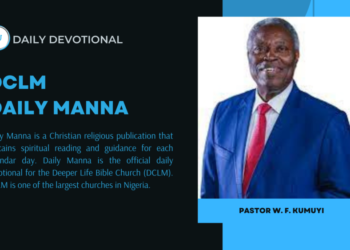


DCLM Daily Manna 21 October 2026: Called To Bless
KEY VERSE: “Not rendering evil for evil, or railing for railing: but contrariwise blessing; knowing that ye are thereunto called, that ye should inherit a blessing” (1 Peter 3:9).
TEXT: 1 PETER 3:7–9
In the same way you married men should live considerately with [your wives], with an intelligent recognition [of the marriage relation], honoring the woman as [physically] the weaker, but [realizing that you] are joint heirs of the grace (God’s unmerited favor) of life, in order that your prayers may not be hindered and cut off. [Otherwise you cannot pray effectively.]
8 Finally, all [of you] should be of one and the same mind (united in spirit), sympathizing [with one another], loving [each other] as brethren [of one household], compassionate and courteous (tenderhearted and humble).
9 Never return evil for evil or insult for insult (scolding, tongue-lashing, berating), but on the contrary blessing [praying for their welfare, happiness, and protection, and truly pitying and loving them]. For know that to this you have been called, that you may yourselves inherit a blessing [from God—that you may obtain a blessing as heirs, bringing welfare and happiness and protection].
READ OTHER DCLM DAILY DEVOTIONAL HERE
Mary Marty retells a parable from the Eye of the Needle newsletter: “A holy man was engaged in his morning meditation under a tree whose roots stretched out over the riverbank. During his meditation he noticed that the river was rising, and a scorpion caught in the roots was about to drown. He crawled out on the roots and reached down to free the scorpion, but every time he did so, the scorpion struck back at him. An observer came along and said to the holy man, ‘Don’t you know that’s a scorpion, and it’s in the nature of a scorpion to want to sting?’ To which the holy man replied, ‘That may well be, but it is my nature to save, and must I change my nature because the scorpion does not change its nature?’”
This passage offers a rich blueprint for Christian relationships, beginning in the home and extending into the wider community of faith. Peter instructs husbands to live with their wives in an understanding and honouring way, by showing emotional sensitivity, spiritual partnership, and shared dignity, while recognising them as co-heirs of God’s grace, so as to avoid the consequence of hindered prayers.
Itemising the qualities expected among Christian communities as, having unity of mind, sharing in each other’s struggles, loving one another as family, having tender heart and humble mind, Apostle Peter concludes by giving the challenge of “not rendering evil for evil, or railing for railing…” a character trait that exemplifies Christ who blessed those that crucified Him.
Therefore, whether in marriage or family, we are to commit to treating others with understanding and grace. We are not to respond to insults, betrayals, or mistreatment with vengeance. Instead, we are to bless, speaking well, praying for, and seeking good for those who hurt us. When we bless instead of curse, love instead of retaliate, we live out the gospel and step into the flow of God’s blessing for our own lives.
THOUGHT FOR THE DAY: Blessing those who hurt us makes us to resemble Christ.
THE BIBLE IN ONE YEAR: Proverbs 1–3
DCLM Daily Manna 21 October 2026